

Transactional truth
ERP, POS, labour and inventory systems record declared activity and measured outcomes.

Operational Assurance Layer for Network Value Protection
RCOps is built for coffee, franchise, multi-store F&B and bakery/snack takeaway networks. Through recurring field cycles, it verifies real store execution, estimates the exposure of material deviations, assigns corrective ownership and rechecks the correction. HQ gains a governed network view, while Store Owners gain a focused path to reduce correctable leakage, protect margin and improve service.
Scroll to follow the operating loop↓
The operating environment has changed
01 → 02Organised foodservice is becoming larger, more multi-brand and more investment-mature, while becoming harder to control through financial data alone. Labour and productivity pressure, ingredient costs, delivery commissions and intense local competition reduce the margin for repeated execution error. These structural pressures are not automatically operational leakage. RCOps establishes where correctable store-level deviations are amplifying them.
03 / The operational reality gap
Sales, labour, inventory, audits and KPIs create essential management visibility. Area Managers and Store Managers add operating knowledge and intervention. Yet skipped processes, unmanaged queues, unrecorded remakes and corrections that exist only in an email can remain fragmented, normalised or undocumented until their effect appears in performance.

ERP, POS, labour and inventory systems record declared activity and measured outcomes.
Internal reports and operating leaders explain context, coach teams and drive day-to-day execution.
Some behaviours and failures never become a field in a system or a consistent written report.
When the financial pattern becomes visible, the operating cause may already be recurring across locations.
The physical shift
Your systems show what was recorded. RCOps independently verifies the operating conditions observed during each field cycle.
04 / What RCOps does in the field
RCOps follows real store activity through a consistent observation and evidence framework. Findings are structured, comparable across locations and supported by decision-relevant proof rather than informal impressions.

Confirm whether the store, equipment, team and products are ready for trade.

Observe product execution before and during service.

Follow how labor and leadership respond when demand increases.

Examine the interaction between counter demand and platform orders.

Compare product use, recorded stock and avoidable loss.

Check whether the operation closes with the required discipline.
Coverage spans customer journey, product execution, hygiene and SOP, digital and delivery operations, waste and stock, labour deployment, management behaviour and previously claimed corrections.
Mystery Shopping may contribute one customer-moment evidence source. RCOps investigates the operating system behind repeated outcomes.
05 / From failure to financial exposure
Repeated execution failures can contribute to waste, remakes, missed sales, service friction, labour inefficiency, brand inconsistency and franchise instability. RCOps connects validated field evidence with documented assumptions to estimate exposure and prioritise intervention by materiality, severity and recurrence. For Store Owners, this identifies which correctable leaks may be suppressing profit and where recovery should start.
06 / From finding to owned intervention
A finding does not recover performance by itself. RCOps helps HQ and the Store Owner or responsible store operator distinguish visible symptoms from evidence-supported likely operating causes, separate what the store must correct from what HQ must support, and focus on the few actions with the greatest operational importance. Material findings become corrective cases with a priority, accountable owner, expected outcome and target date.
Examine the operation during real store activity.
Record the evidence needed to define the observed condition.
Check completeness, consistency and decision relevance before escalation.
Use the available evidence to distinguish a likely operating cause from the visible symptom and record uncertainty where needed.
Estimate operational and financial exposure through documented assumptions.
Rank action by materiality, severity and recurrence.
Assign the action to a Store Manager, Store Owner, Area Manager, HQ function or shared ownership, with an expected outcome, deadline and SLA.
Preserve the original evidence and define what must be observed again before the case can close.
The objective is earlier, better-directed intervention: give a store under pressure a manageable recovery path, make the required HQ support actions visible and act before repeated drift becomes deeper financial or franchise pressure.
07 / Follow-up and verified closure
Priority findings enter a recovery loop. RCOps returns to the same operating condition, evaluates it again and captures new evidence. Unresolved or repeated failures remain visible; closure is accepted only when the correction is independently confirmed.
A response, photograph, email or checked task may show that activity was reported. It does not independently prove that the underlying condition changed during real operation.
Follow-up examines the original issue again, records what changed and keeps the case open when evidence is insufficient, the failure repeats or escalation remains necessary.
A finding is not closed because somebody reported it as completed. It is closed when follow-up evidence verifies correction.
An anonymised product sneak peek
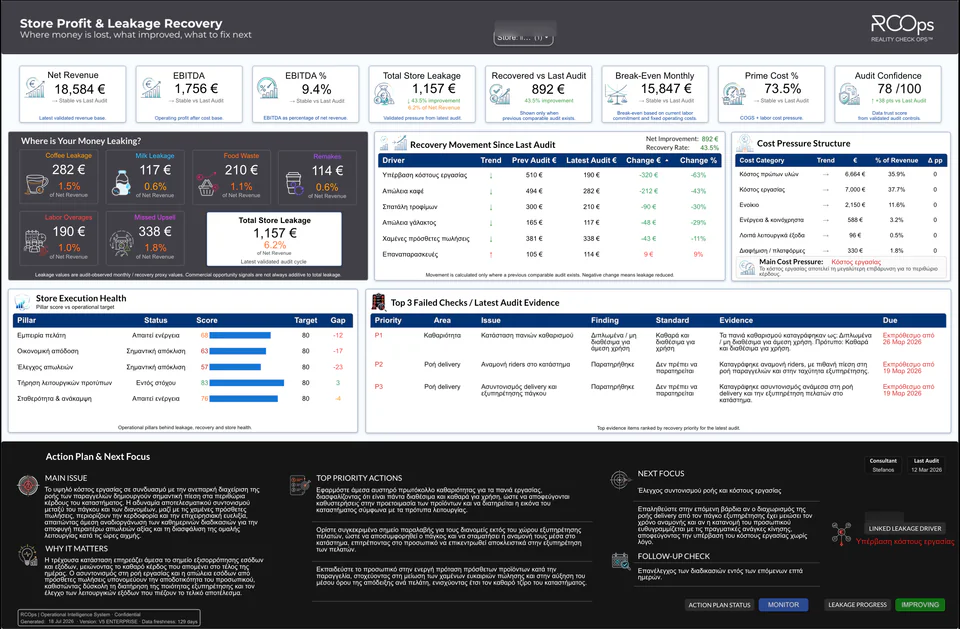
Which correctable leaks are reducing profit—and what recovery plan follows?
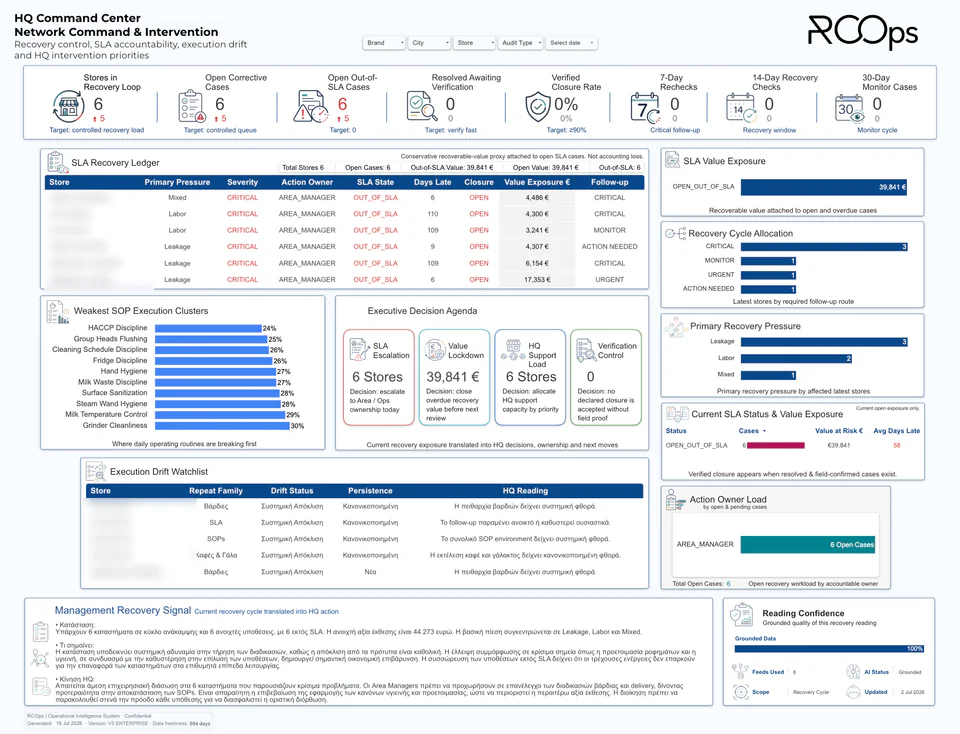
Where must the network intervene first?
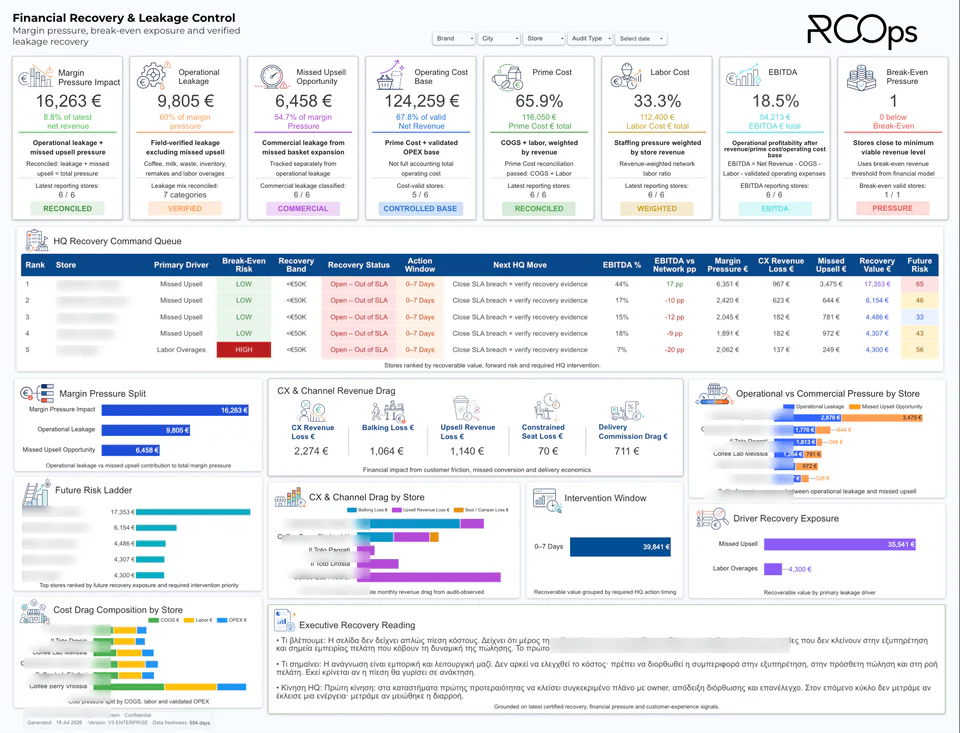
Which pressure carries the greatest recoverable value?
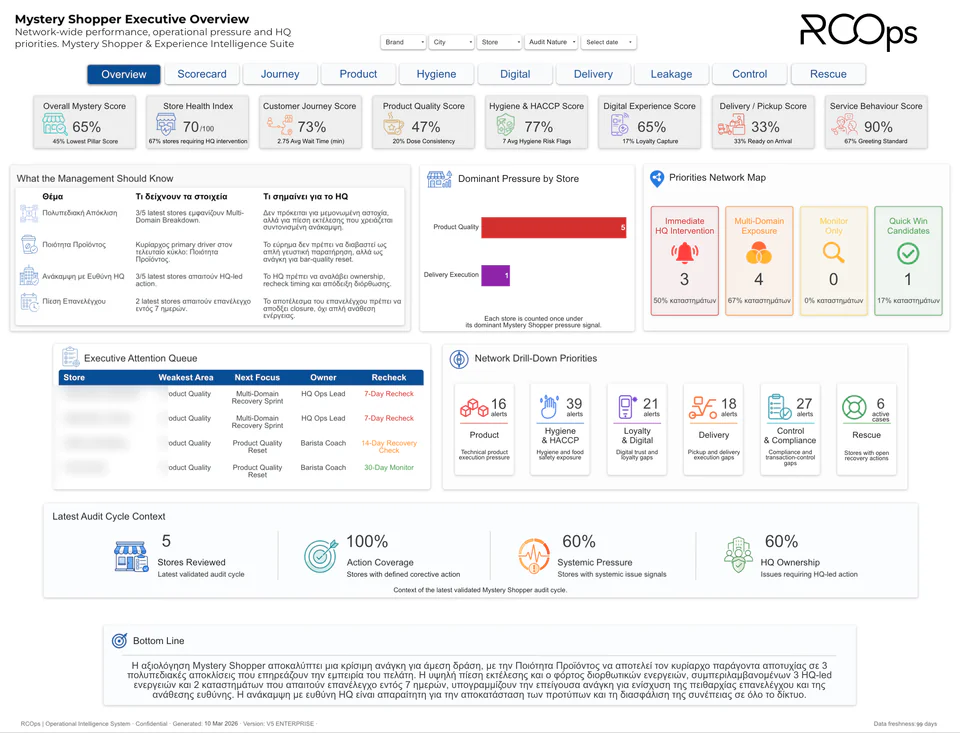
What do repeated customer and execution signals reveal?
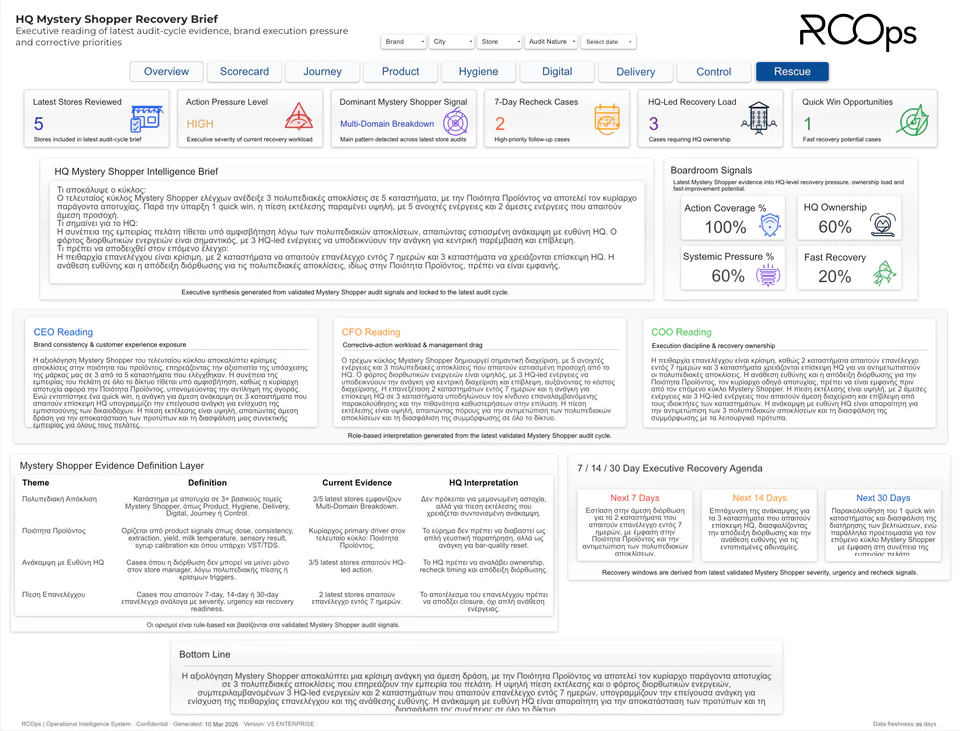
How does the latest field cycle become a clear 7, 14 and 30-day agenda?
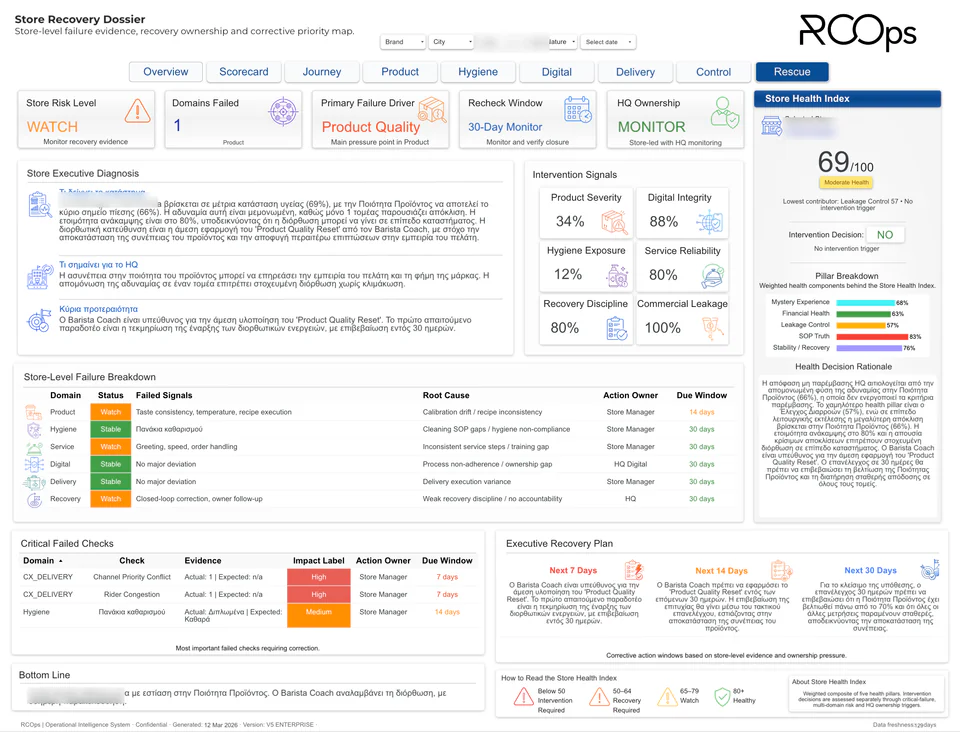
What failed, who owns the response and what evidence will prove recovery?
08 / Operational assurance for network value protection
The market already has ERP, POS, BI, telemetry, procurement systems and increasingly sophisticated operating teams. Each remains essential, but none independently verifies the physical execution behind the numbers. RCOps is not another reporting layer. It operates as an Operational Assurance Layer, combining Operational Intelligence, Independent Verification, Financial Quantification, Accountability and Verified Closure. A dashboard may present the result; the value lies in the governed path from field evidence to confirmed correction.
Captures a customer experience at a particular moment and is valuable for service, behaviour and brand-experience checks.
It generally cannot establish the complete operating and financial system behind a repeated outcome.
Multi-domain operational validation, exposure estimation, owned intervention, follow-up and verified closure. Mystery Shopping can be one RCOps evidence input; it is not the identity of RCOps.
Consolidates, calculates and visualises available data for executive reporting and trend analysis.
A dashboard cannot observe physical behaviours or unrecorded events that never entered a source system.
Structured field-reality data, validation of the conditions behind performance and a governed link from evidence to action. BI may be an output; the dashboard is not the product.
Coach stores, maintain relationships and manage execution as essential internal operating leaders.
Their role is internal and relationship-led. HQ may still need a separate, standardised evidence base for cross-network comparison, prioritisation and independent closure verification.
Independent, standardised evidence, material intervention priorities, ownership, deadlines and closure status—without replacing the Area Manager.
Record sales, purchasing, transactions, inventory, labour and declared events as essential systems of record.
They cannot independently explain why a process failed physically inside a store.
Investigation of the execution behind the numbers and connection of physical or behavioural causes to the transactional picture.
Confirm standards, policy execution and defined compliance controls for governance and brand protection.
Periodic or pass/fail checks do not automatically establish financial priority, owned recovery or verified correction.
Cross-functional materiality, corrective ownership, follow-up and evidence-based closure. RCOps does not provide legal food-safety or regulatory certification.
Analyses problems, recommends solutions and may support strategy, design or transformation.
A recommendation alone does not prove that field execution changed.
A continuing operating loop: structure the corrective case, track responsibility and deadline, return to the field and verify closure with new evidence.
Independent field reality, comparable evidence and financial prioritisation.
It does not replace source systems, internal leaders or specialist assurance functions.
The governed connection between field truth, intervention and verified closure.
RCOps does not replace Area Managers. It provides an independent evidence and prioritisation layer that helps HQ and operational teams focus intervention where the financial and network risk is highest.
Operational Intelligence + Independent Verification + Financial Quantification + Accountability + Verified Closure.
09 / Store & HQ Intelligence
The same evidence-to-closure cycle gives each store a focused correction and recovery path while giving HQ a governed network view of risk concentration, ownership, SLA, escalation and verified progress.
RCOps creates a common evidence base for HQ and the Store Owner. For the Store Owner, it isolates correctable leakage, distinguishes store-owned actions from those requiring HQ support and tracks whether recovery improved the operating condition—helping protect margin, strengthen service and support better EBITDA performance.
HQ executive decision views
These are decision views produced by one governed RCOps program—not separate products.Where action is required now and how accountability is progressing.
Where validated field conditions may be contributing to avoidable exposure.
Where operating weakness may be affecting store health and network resilience.
Earlier visibility. Clearer intervention. Verified correction.
10 / For investors, buyers and multi-store operators
This transaction-specific RCOps engagement gives an investor, buyer, prospective franchisee or multi-store operator an independent, field-based view of an existing store or group of stores before capital is committed. It examines the operating conditions behind reported performance, identifies material execution and cost-control risks and clarifies who will govern execution after acquisition or rapid expansion. It also tests whether network averages are hiding operational risk across airports, islands, malls and different store formats.

Transaction-specific applicationPre-Acquisition Store Viability & Upside Assessment
The operating condition observed across the agreed fieldwork scope
Material execution, cost-control and management-discipline risks
Evidence-supported likely operating causes and critical dependencies
Estimated operational and financial exposure, with assumptions and limitations
Corrective priorities, likely intervention burden and areas requiring deeper specialist diligence
Understand what is working, what is fragile, what is correctable and what level of operational intervention may be required after acquisition.
This is operational due diligence, not a valuation, certification or investment recommendation. It complements and does not replace financial, accounting, legal, tax, commercial, property, engineering or regulatory due diligence.
Discuss a Pre-Acquisition Assessment11 / Controlled Executive Demonstration
A focused working session for Store Owners, HQ leaders, investors and buyers who need stronger field evidence, operational-risk visibility, corrective priorities and a clear path from findings to action.
No connection to live client systems or production data.